
One of the things that makes Australia so amazing is its multiculturalism. This country often gets a reputation as a place with “no culture”.
I disagree. You just have to know where to find it.
In Melbourne, there are so many vibrant cultural pockets dotted around. Oakleigh’s Eaton Mall, which boasts full tables and exquisite Greek cuisine late into the evening, comes to mind. So too does Lygon Street, the famous Italian hotspot. Then there’s Box Hill, which makes you think you’ve somehow wandered into another country, with its bright lights and plentiful Chinese restaurants.
As you can maybe tell, food is often my entry point into new cultures. As a young kid, before I had met many people or watched many movies, food was how I learned about the world.
At the age of six, my parents took me to see ‘Horton Hears a Who’. It’s my earliest memory of going to a cinema. As an extra surprise, we ate dinner beforehand at a Greek restaurant. I had never tried saganaki, taramasalata, or gyros before, and I instantly fell in love. I raved about it for weeks. I vaguely remember the Greek-style crockery, music, and décor, all new to me at the time. And so, my concept of ‘Greece’ was born.
On another occasion, in what has become an infamous story in my household, my older brother Lachie (around 10 at the time) had specifically requested that we go out for Chinese food for his birthday. In a move that still bewilders him to this day, our mum flat out refused and declared we would go out for Thai food instead (more sophisticated, she insisted). My brother cried himself to sleep that night (I know because we shared a room at the time), but after our exquisite meal, he rather sheepishly declared that he had a new favourite cuisine.
This was my first introduction to Thailand. I still remember the white tablecloths, red napkins, and the funny little ribbed bowls that made a horrendous noise when I scraped off the last scraps of satay chicken. I remember the Thai waitress who took our order; I’d never noticed a waitress pull out their notepad and write down an order before, but for some reason, I noticed it that night. As a hospitality worker myself, I now realise that our table was just one of the many hundred orders she would have taken that week, but for 6-year-old me, she was some sort of angel blessing me with this new cuisine. As I sat in that little Thai restaurant, just like before, my concept of ‘Thailand’ was born.
This continued throughout my childhood. Butter chicken taught me about India, tacos about Mexico, and paella about Spain. We were never exactly what you’d call a ‘cultured’ family. We didn’t go on big overseas trips, nor did we watch television programs highlighting global cultures. As far as I knew growing up, other cultures were their foods.
There is so much more to culture than food, though, and things like styles of dress, ceremonies, and religious traditions feel completely foreign to me. Growing up, I celebrated Easter and Christmas, but they were stripped of their historical and religious significance in my agnostic household. They were mostly just a good excuse to get together as a family and eat nice food, done because that was the ‘done thing’. Nothing wrong with this of course, but it means that the holidays and traditions observed in other cultures, so rich with meaning and rituals, are a little daunting to me.
Fasting for Ramadan gave me a sliver of insight into the “practices and traditions” side of culture, but I want to know more. Melbourne is a multicultural place. I’m sure there are many people in my life—colleagues, fellow students, friends, etc.—who partake in cultural practices that remain entirely invisible to me. The more I learn about cultural practices, the better I can connect with the people in my life and the strangers I encounter.
With Greek Easter approaching, and Melbourne being home to the largest Greek population outside of Europe, I decided this was the perfect opportunity for my next foray into a new culture.
That’s why this week I: Took part in Pascha (Greek Easter).
My usual bedtime rolled around, but I didn’t start getting ready for bed. It was 9:30 and there was still over an hour before I would leave for the midnight service. I used this time to do some research on “Pascha”—the proper Greek name for Greek Easter. Similar to Catholic Easter in its celebration of the resurrection of Jesus Christ, Pascha has some unique traditions, many of which I was lucky enough to experience over the next few hours.
I was excited, but honestly a tad nervous. I didn’t know what to expect, and I worried that I would have to say, do, or sing something that I wouldn’t have a clue about. I felt out of my depth, but I reminded myself that that’s exactly why I was doing this in the first place. Plus, I wasn’t doing it alone.
My good (Greek) friend Dorian was kind enough to invite me to the midnight service with him and his family. I had practically grown up at his house, but I hadn’t been in years. I arrived just before 11 pm, and it was such a joy to reunite with his family who I had seen so often in my youth.
We arrived at the church 45 minutes early, and already there was a massive queue to enter. We would not be making it inside, but that was okay; we hadn’t expected to. The vast majority of attendees congregate outside of the church like we did. Dorian’s mum handed me my very own Lambada—a decorated candle that is very significant to the proceedings.
We stood around chatting until Saturday became Sunday and the lights suddenly went dark. There was a moment of hushed anticipation before music started emanating from the open church door. Soon the priest stepped out, followed by a candle-wielding brigade of churchgoers. I watched the first one descend the front steps and, with an earnest look on his face, light the candle of a stranger. The stranger received his flame intently, then passed it on to the next person. What began as a handful of lit candles at the mouth of the church quickly swept across the crowd like a wildfire in the wind, and I was swiftly surrounded by flame.
The priest began to sing, and the crowd joined in. It was entirely in Greek, although I caught the words “Christos Anesti” (“Christ has Risen”). This was what I was most apprehensive about: having to do something I didn’t know how to do. In the moment though, I wasn’t worried about not knowing the lyrics. I was too caught up in the awe of the moment. The religious significance may have been lost on me, but it was apparent in the hundreds of faces around me, and that was still powerful.
After a rather lengthy rendition, the singing ceased, the lights came on, and a handful of whispers quickly swelled into a loud hum. We told each other “Christos Anesti” and embraced, in the way that you would wish a loved one a “Happy New Year” as the clock strikes midnight.
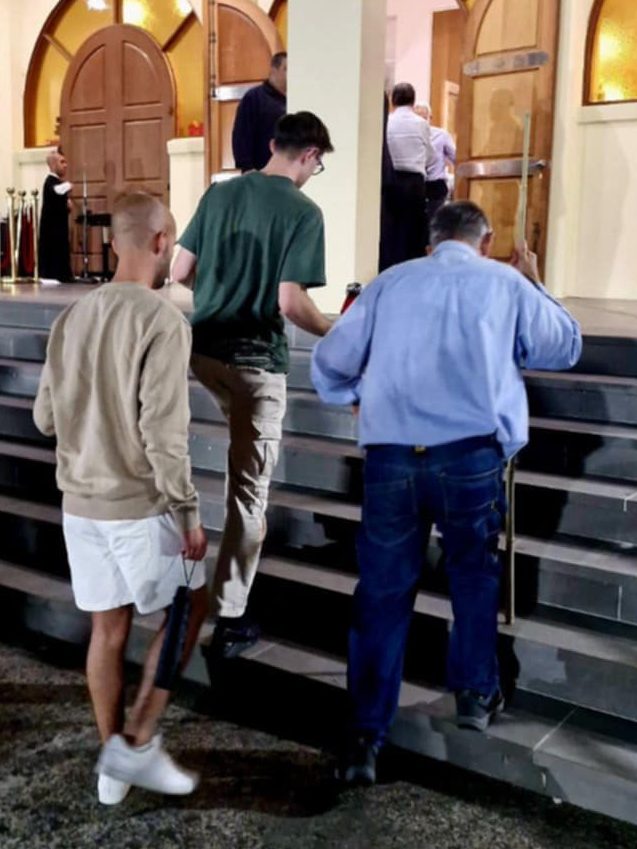
I met up with Dorian’s Papou, who offered to take me inside the church. I obliged, and I was quite literally dragged by the arm inside. Its resemblance to the orthodox churches I had seen in Greece surprised me, covered wall to ceiling with intricate paintings. I didn’t realise we had such beautiful churches here in Melbourne.
The crowd thinned out pretty quickly, and we headed back to Dorian’s house. His mum had prepared a loaf of Tsoureki for us—a sweet bread flavoured with lemon and orange zest made specifically for Pascha. It wasn’t lost on me that for perhaps the first time, I had experienced the ceremonies and traditions of a culture before their food. However, as I sat around the kitchen table devouring slice after slice and catching up with a family that I love so much, it confirmed to me that food is the most important part of culture to me, and that’s okay. The fact that I associate culture with food isn’t a weakness, it’s just the way I am.

That being the case, I still put myself out there and experienced a new side of a new culture. When I think of Pascha now, it won’t just be about the food, and that’s kind of cool. I now have a much better idea of what Pascha is, and what it means to the Orthodox community, and that knowledge is only going to help bring me closer to the people around me.
UPDATE: Hours after finishing this post, this newfound experience had already come in handy. I arrived at work and went to the staff room, and what else sat on the table but a loaf of Tsoureki! Standing next to it was my Greek co-worker Elise, who had also attended a midnight service that morning, and we chatted about the experience. It validated to me the importance of branching out and learning about other cultures firsthand, and that felt good.
Did I enjoy it, and would I do it again? I definitely enjoyed it and will look to experience other ceremonies and traditions from various cultures in the future.

 This Week I...
What should I try next?