
I’m a relatively skinny guy, so one might be forgiven for thinking I don’t eat much. This is a common misconception. While I rarely gorge on unhealthy foods, I do eat often and in considerable quantity.
I am also a major ambassador for nature’s greatest drink: water. I usually have two or three different glasses going around the house at once (to be fair, more due to my ADHD and shocking memory than my love of water), and drink almost constantly throughout the day.
I’ve never tried fasting or restricting my diet. The closest I’ve come to altering my diet is increasing my caloric intake to put on some size in the muscles department (to little avail I regret to say). Therefore, I figured fasting would be a good way to push me outside of my comfort zone.
Deciding how I should structure my fast was difficult, however. Choosing what to give up and for how long seemed like an arbitrary decision, and I didn’t want to make it too easy or too difficult on myself. That’s when I remembered something I’d heard of in passing: Ramadan.
For the uninitiated, Muslims around the world participate in a fast called Sawm during the month of Ramadan (the ninth month of the Islamic calendar). During this month, nothing may pass your lips between dawn and sunset each day. That includes food, water, medication, gum, cigarettes, and so on. (As far as I can tell, the only thing you can put in your mouth during sunlight hours is a toothbrush—provided you don’t swallow the toothpaste).
I’ve never known a great deal about Muslim culture, but whenever I’ve heard murmurs about Ramadan in the media or from a friend’s friend, I’ve always thought the same thing: “Mate, I could NEVER do that”.
And that’s how I knew I had to try it.
Now as a disclaimer, I hesitate to say that I fully participated in Ramadan, as there’s a bit more to it than just abstaining from food and water (not to mention I fasted for only a week). I didn’t pray or study the Quran, and I wouldn’t want to offend anyone by pretending I’m now some expert on Muslim culture. However, this whole endeavour started with me wanting to fast, and the parameters set out in Ramadan gave me a good place to start.
So, with that all out of the way, this week I: fasted for Ramadan.
Waking up to my alarm clock reading “4:50 am” on that first morning was not the hottest of starts, I’ll admit, but the punishment of facing the day on an empty stomach was enough to drag me out of bed.
My mate Flynn—who I somehow dragged into fasting with me—hosted me for Suhur (the pre-dawn meal) on the first day. We also somehow convinced our friend Angelo to join us for a 5:30 am breakfast, even though he wasn’t fasting. We sat around, ate our specially designed high-protein breakfasts, and gulped down as many glasses of water as possible. It was really nice honestly. How often do you get to have brekkie with two of your best mates?
As the day wore on, I was surprised at how easily I coped. Inexplicably, I felt less hungry and less thirsty than usual! The most difficult thing was the fatigue. Running on less than six hours of sleep was far more of a hindrance than the lack of food and water.
As sunset rolled around, I was back at Flynn’s house for dinner. We started preparing dinner an hour before sunset, and though we hadn’t eaten in over 12 hours, it was surprisingly easy to resist the urge to eat while cooking.
After the first day, I’d learned my lesson and went back to sleep after eating breakfast. This turned out to be a great decision, as my focus, energy, and positivity were so much higher as a result.
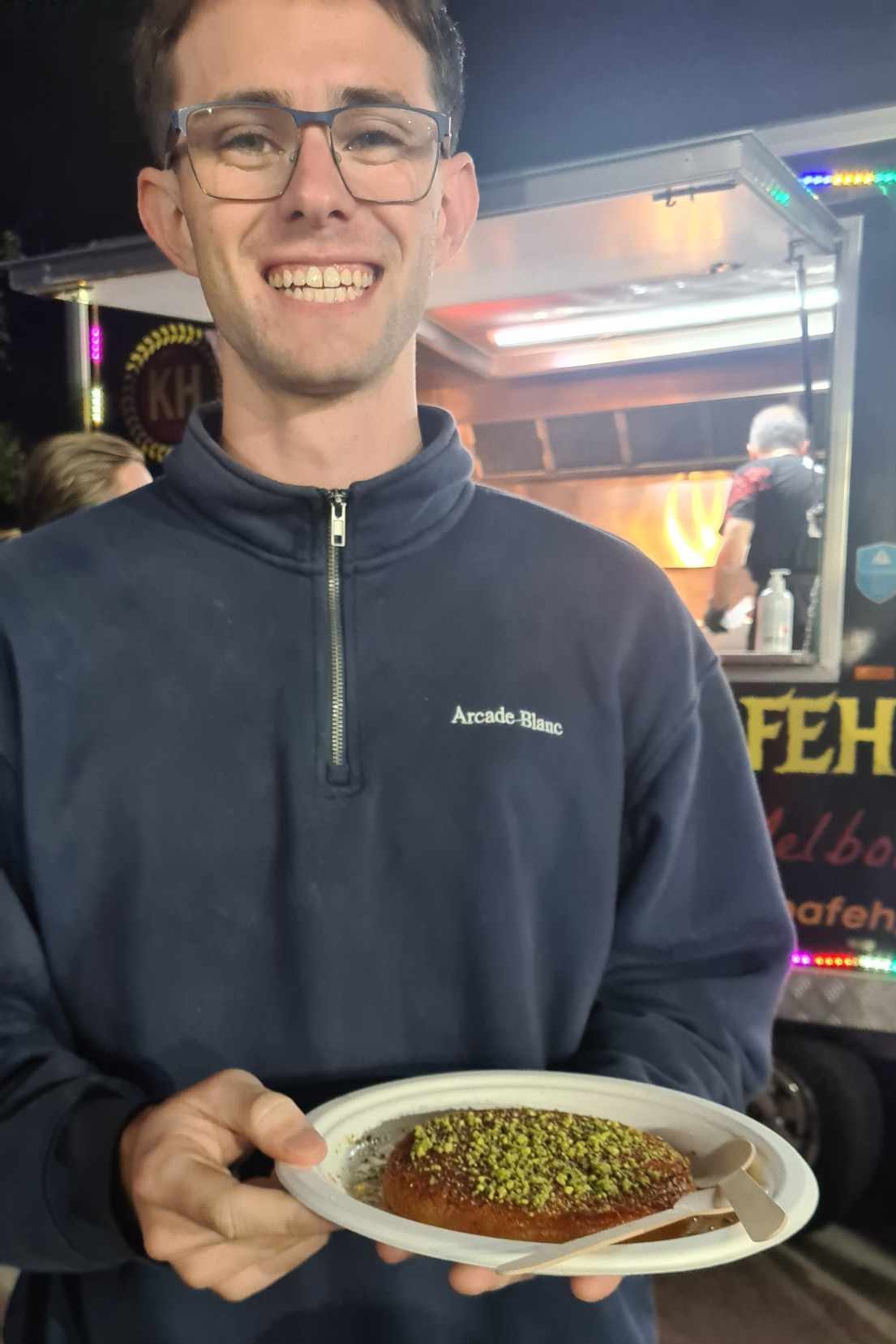
The second night was a real highlight, as I attended a Ramadan Night Market in Melbourne’s Northern suburbs. The place was buzzing, the people were friendly, and the food was unbelievable. I devoured a lamb kofta wrap with plenty of hummus and salad and followed it down with a sweet and savoury concoction called knafeh. A mix of pastry, syrup, cheese, and pistachios, it was certainly like nothing I’d ever tried.
I won’t bore you with the details of days three through seven, but there were a few overall takeaways of interest.
The first was, again, how doable it was. I never felt tempted to give up, even when a midday event I attended was fully catered. The thirst, which I expected to be chronic, was hardly a factor, even after playing tennis or going to the gym most days.
I also came to appreciate how much I eat and drink through boredom and routine, rather than due to hunger and thirst. Deep down I already knew this to be the case, but experiencing firsthand how little hunger and thirst I faced throughout the day made it blatantly clear. Especially at the start of the week, I had MANY micro thoughts in the back of my mind to grab a glass of water or a snack. Left unchecked, these countless moments throughout the day are mostly what motivates me to eat, not true hunger or thirst.
Finally, I felt grateful. Even though I wasn’t overly hungry or thirsty, reflecting on how often I usually eat and drink gave me a greater appreciation for how accessible these necessities are in my life, and that’s something I’m incredibly grateful for.
Did I enjoy it and would I do it again? Enjoy doesn’t really feel like the word to use here. Did I enjoy starving myself? No. But I did take a lot away from the experience. As to whether I would do it again, I really have no idea. I wouldn’t be in a rush to, but I think it would be good to fast for a single day here and there to remind myself to be patient and grateful.
What did I learn? I learned a lot! I learned to be more grateful for what I have, to be more patient with food and water, and that I don’t always need to grab that extra snack or sip of water. Perhaps above all else, I got a taste of a culture that I previously knew so little about.

 This Week I...
What should I try next?